Call scheduling for independent physician groups
We make bad schedules difficult and good schedules easy.
PostCallMD is call scheduling software with the guardrails built in: the post call stays protected, the workload stays fair, and making the schedule stops eating anyone's nights and weekends.
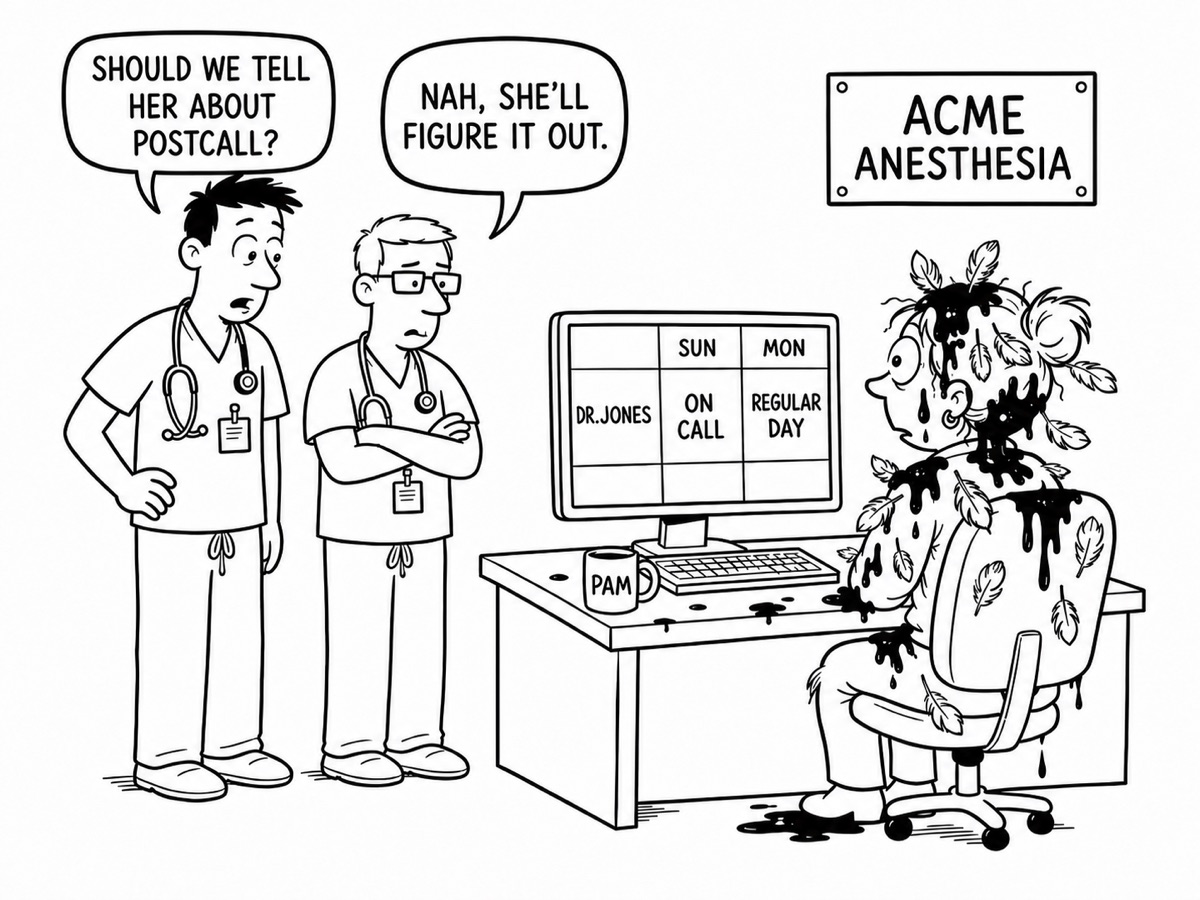
“Scheduling used to involve two partners working nights and weekends with pencil, paper and excel. Now, I can knock it out in minutes from my phone.” Partner at an independent anesthesia group
PostCall Protection
The rule your group already has, finally enforced.
Every group that takes call has the rule: work the night, get the next day. And every group has watched the rule bend when coverage gets tight.
PostCall Protection puts friction exactly where the rule bends. You can still schedule a doctor post call. But the reason gets logged, the physician's name has to be typed in to confirm, and their post-call count doesn't go unnoticed.
Fairness stops being a feeling and becomes a number.
| Doctor | Sun121/1 | Mon131/2 |
|---|---|---|
| Dr. Fishman | ||
| Dr. Snook | CALL | |
| Dr. Echols | CALL |
Live demo. Monday still needs an OR doc. Click an open Monday cell.
| Date | Clinician | Shift | Reason | Overridden by |
|---|---|---|---|---|
| Oct 13 | Dr. Echols | OR | You |
Request Hub
Every schedule request in one place, even the messy ones.
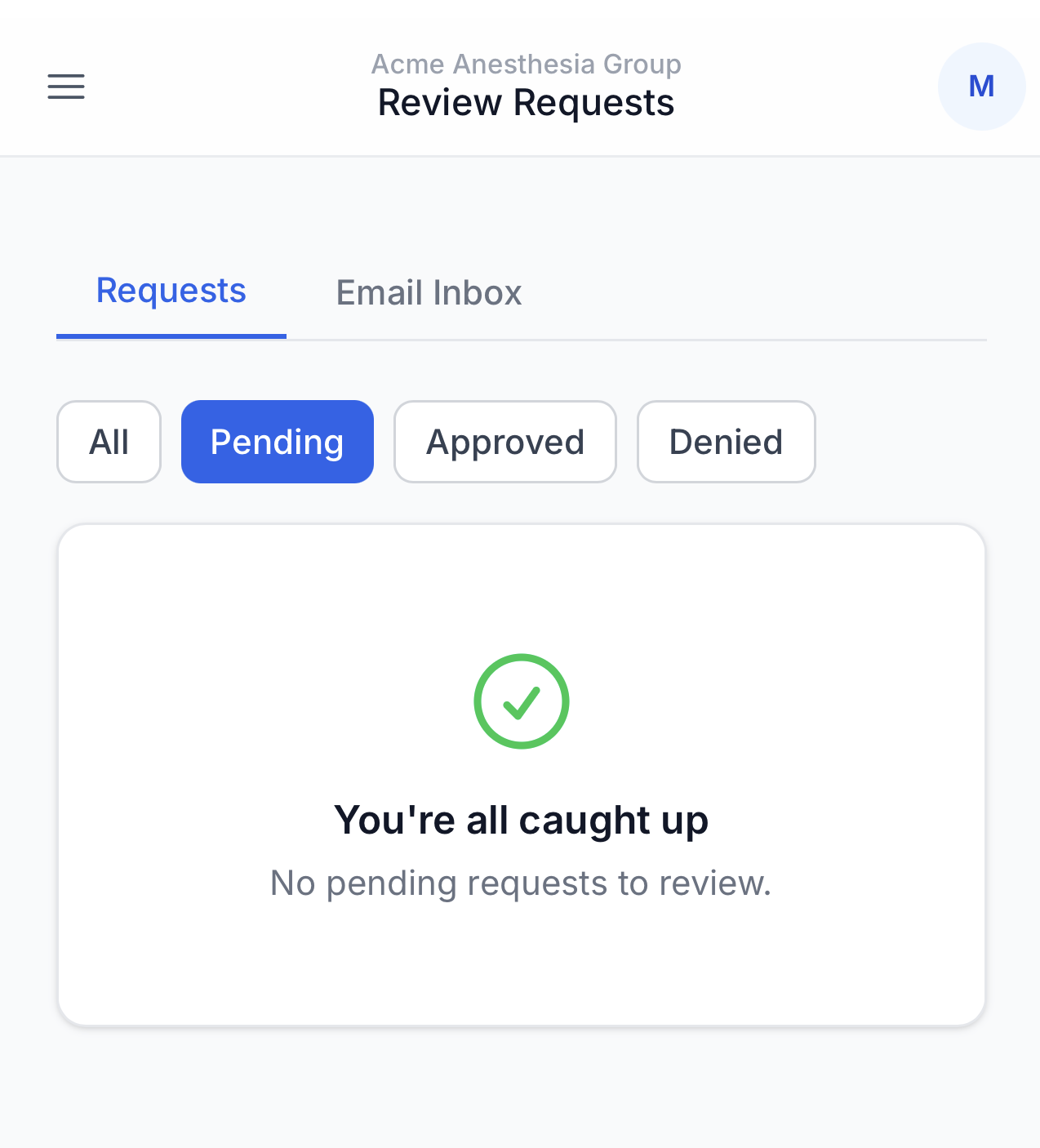
Doctors ask for days off from the app on their phone, or they just email the way they always have. Either way it lands in one queue.
The emails don't have to be tidy. The AI agent reads “hey, any chance I could get the 14th, and also swap my Friday with Priya if she's ok with it” and turns it into two clean requests with dates attached. The admin taps approve or deny.
No more digging through June's texts and emails looking for October requests.
Call Wizard
Far from perfect, and better every cycle.
To start, we sit down with your scheduler and a few of your doctors and learn what a fair schedule means in your group. Then we build a solver1 custom to those rules. There is no configuration on your end, and no settings page with four hundred toggles.
You get a button. It generates a draft schedule from your rules, vacations, history, capabilities, and requests. You review the draft, change what you disagree with, and publish when it is right.
Each cycle we take your feedback and dial the solver in.
While the solver won't eliminate all the scheduling headaches, it will give you an optimal schedule. If someone doesn't like it, they can blame the computer.
- Cardiac days take two cardiac-capable docs, neither post call Hard
- Vacation never starts post call Hard
- Dr. Cherry and Dr. Brown never work the same weekend Hard
- At least four days between call shifts Soft
- No back to back weekends Soft
1. The engine under the button is CP-SAT, the constraint solver in Google's OR-Tools. Operations research, not operating room. It is the same open-source solver Google built for its own scheduling and routing problems, and it weighs millions of candidate schedules against every rule on the sheet before it hands you one.
Draft Runner
The vacation draft, without the reply-all.
If your group drafts vacation or holidays, you know the loop: update the sheet, email the next doc, wait for a reply. Update the sheet, email the next doc, wait. None of it is hard. It's just tedious. You're stuck in the loop.
With Draft Runner, the draft runs itself. Set it up once. It emails each doctor when their turn comes, shows them what is still open, and locks picks as they are made. Selections land in the database in order, already there come scheduling time.
The draft that used to keep you trapped in the loop, runs itself.
- 1Dr. Fellertook Thanksgiving off
- 2Dr. Rosetook Christmas Eve
- 3Dr. Nguyenpicking now · emailed 8:02a
- 4Dr. Cherryup next
- 5Dr. Brown
It runs from a phone
Everything in PostCall works from a phone. Publish a schedule from the carpool line. Approve a swap between cases. The people who make the best schedules do not just sit at desks. They are in the OR, taking care of patients, and the software meets them there. For power users there is a full desktop app.
Mostly one person, who tunes your solver every month
PostCall is mostly one person, and on purpose. When your group signs on, the person who sits with your scheduler to learn your rules is the person who builds your solver by hand. Then, every month, the same person tunes it against what actually happened. Nothing gets lost between support tiers, because there are none. The schedule that used to take a weekend takes an evening, then an hour, then five minutes. And the doctor is still the one in control.
Scheduling getting lighter every month is the product.
Mostly one person is also the honest risk of working with us, and it deserves a real answer instead of a shrug. So the answer is in writing: your data exports at any time, the solver is open source, and if PostCall ever winds down, active customers get the production code that builds their schedule. The rest of the questions you should ask a small vendor are answered on our trust page.
PostCall is for independent medical groups who take call and own their own schedule. We started in anesthesia and we know it best: multi-site coverage, cardiac rooms, supervision ratios. If that sounds like your group, we should talk.
Twenty minutes, and you leave with a quote
Pricing is per group. It depends on how many doctors, how many sites, and how gnarly the rules are, so quotes happen in a conversation, not a rate card. The conversation is with me, Moultrie Ball. I built PostCall and I build every solver, so you will not be talking to sales. You leave with your number, what onboarding would look like, and no follow-up drip if the answer is no.