Anesthesia call scheduling
Anesthesia call scheduling, built from your rules.
We build a constraint solver around your real rules — post-call rest, site coverage, partner pairings, vacation glide paths, fairness history — stand it up in a system of record your group actually uses, and dial it in with you. You review every draft. If your group does not accept the first schedule, you do not pay.
Built for independent anesthesia groups of about 14 to 40 clinicians. Not for hospitals. Your scheduler does not configure software or build the month by hand — we run the solver, and the schedule lives in one place the whole group can see.
Proof, before anything else
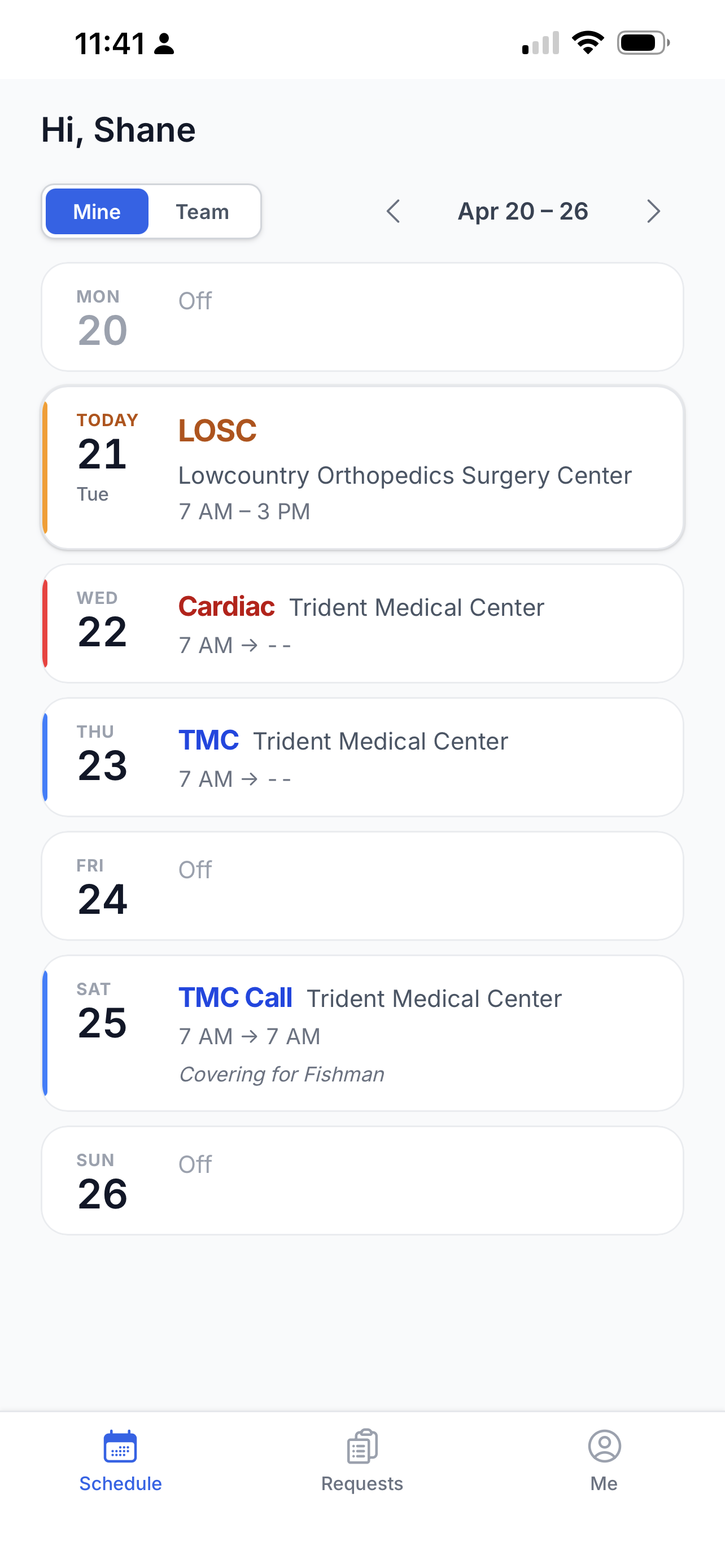
Trident has not touched the call spreadsheet since November 2025.
Trident Anesthesia is a twenty-five-physician group covering two hospitals and six surgery centers. Before us, one of the partners spent his nights and weekends building call. Every month, for years.
Since November 2025, every published Trident schedule has come through our solver. The same model runs each month, accounting for contract employees getting their committed shifts first, partners absorbing the remainder, post-call cardiac requirements, partner pairings the group avoids on weekends, and a year-long vacation glide path so no one physician feels squeezed in December.
The guarantee. If your group does not accept the first schedule, we do not invoice the pilot. We can offer that because rule-capture happens before any schedule is generated — interviews, past-schedule import, request collection, and a fairness review.
The honest part
We are small. Here is why that is safe for you.
PostCall is a small team. A larger vendor will point at that and call it a risk. We would rather remove the risk in writing than argue about it, so you are not betting on us still being here in five years.
You approve before you pay
If your group does not accept the first live schedule, we do not invoice the pilot. That is the guarantee above, and it is written into our terms, not just promised here.
You are never stranded
Your schedule data is yours and exportable at any time. The base solver is already open source. And if PostCall ever stops operating, active customers get the production code their schedule runs on, with a perpetual license to keep using it. Also written into the terms.
The reason we can promise that is the same reason we are small: the person who owns this company is the person who answers for it.
“I cannot sleep at night selling something that does not work. If it does not work for your group, I will make it right, or we have no business doing business together. I am in control of this company, and I can promise that personally.”
— Moultrie Ball, founder
What good looks like
A good anesthesia call schedule has to prove the tradeoffs
Most bad call-schedule arguments are not really about one assignment. They are about whether the process was consistent. A workable schedule should make the tradeoffs visible enough that the scheduler can explain them without rebuilding the spreadsheet from memory.
Coverage is complete
Every required site, role, backup slot, and call type has an eligible clinician assigned.
Requests are accounted for
Vacation, no-call days, conferences, and approved exceptions are visible before the schedule is published.
Rest rules are defensible
Post-call recovery and minimum gaps are handled before someone gets assigned into an unsafe or unfair stretch.
Fairness is measurable
Total call, weekend call, holidays, backup burden, and prior history are tracked separately instead of waved away.
Requests
Every request in one place, automatically.
Ask a scheduler where requests live today and you get a list: email, texts, a note from the hallway, memory. The schedule is only as good as what made it from all of those into the spreadsheet.
With PostCall, clinicians submit vacation, no-call days, and preferences in the mobile app. If someone emails a request in instead, it is added automatically and the solver respects it like any other constraint. Every request is in one list before the draft is generated — nothing to dig out of an inbox, a text thread, or anyone’s head.
Rule handling
Rules PostCall can handle
PostCall is designed to model the rules your scheduler is already carrying around: the written policies, the local exceptions, and the soft preferences that matter when there is still more than one workable answer.
- Post-call rest and minimum gaps between call assignments
- Vacation blocks, no-call days, and approved time away
- Site eligibility, credentialing, and subspecialty coverage
- Daily headcount requirements by facility or call type
- Partner, non-partner, FTE, and role-based call obligations
- Weekend, holiday, weekday, and total call distribution
- First-call and backup-call balance
- Call burden carried forward from previous schedules
- Pairing preferences and avoid-pair rules when possible
- Locked assignments when a human decision should stay fixed
A solver does not make the politics disappear. It makes the assumptions explicit, so the scheduler can explain why a tradeoff happened and change the right rule instead of rebuilding the month by hand.
The longer version of how these rules interact — post-call rest, site coverage, partner allocation, weekend fairness, vacation routing — is in our field notes, how an anesthesia call schedule actually gets built. If you are collecting your own rules first, start with the template we send new groups.
Process
Example workflow
Most groups do not need to change everything at once. A practical rollout starts with the spreadsheet you already use and the rules your scheduler already follows.
Send the current spreadsheet
Include the calendar, request tab, call counts, site rules, and any notes the scheduler uses to make decisions.
Turn the rules into constraints
We separate hard rules from preferences: post-call rest, site coverage, vacation blocks, weekend fairness, holidays, pairings, and call burden.
Generate a draft schedule
The solver builds a draft from the inputs. Locked assignments can stay fixed while the rest of the schedule is rebuilt around them.
Review the tradeoffs
The scheduler reviews coverage, call counts, weekends, holidays, and exceptions before anything is treated as final.
Publish and keep one source of truth
Clinicians can see the schedule and submit requests without turning the scheduler’s inbox into the system of record.
For groups comparing enterprise tools, see how this differs from a general QGenda alternative for anesthesia.
FAQ
Questions anesthesia groups ask before changing call scheduling
What is an anesthesia call schedule?
An anesthesia call schedule assigns physicians or clinicians to after-hours, overnight, weekend, holiday, backup, and site-specific call coverage. It usually has to account for post-call recovery, vacations, qualifications, and fairness over time.
Can PostCall use our existing spreadsheet?
Yes. PostCall starts by reviewing the spreadsheet, the tabs around it, and the rules the scheduler uses today. The point is to capture the real scheduling logic before generating a cleaner draft.
Can PostCall account for vacation requests and weekend fairness?
Yes. Vacation blocks, no-call requests, weekend counts, holiday rotation, call burden, and post-call rules can be modeled as scheduling constraints and fairness goals.
How do clinicians submit requests?
In the mobile app, where they also see the published schedule. Requests that arrive by email are added automatically and respected by the solver the same way. Either route, every request lands in one list the scheduler can review before the draft is generated.
Is solver-backed scheduling the same as a spreadsheet template?
No. A spreadsheet template organizes the work, but a solver checks combinations of assignments against rules, coverage needs, and fairness goals. If you only need a starting point, use the anesthesia call schedule template.
Does PostCall replace the scheduler’s judgment?
No. The scheduler still reviews tradeoffs, locks exceptions, and decides what is acceptable for the group. PostCall is meant to reduce manual spreadsheet work and make the rules visible.
Is PostCall a QGenda alternative?
For some anesthesia groups, yes, especially when the priority is call scheduling around local rules instead of a broad hospital scheduling platform. Read more on the QGenda alternative for anesthesia page.
Can ChatGPT make an anesthesia call schedule?
Not safely by itself. ChatGPT can help organize rules or write code, but the final schedule should be produced and checked by deterministic logic. For the DIY version, see the AI call schedule solver walkthrough.
What data do we need to improve our anesthesia call schedule?
Start with the clinician roster, call eligibility, coverage requirements, vacation and no-call requests, prior schedules, weekend and holiday counts, and the local rules the current scheduler uses today.
PostCall is small. What happens to our schedule if you go out of business?
Your schedule data is yours and exportable at any time, and the base solver is open source. Beyond that, our terms commit us to giving active customers the production scheduling code their group runs on, with a perpetual license, if PostCall ever winds down. You keep producing your schedule whether we are here or not.
One rule at a time
Send the call rule you do not think a computer can handle.
Not a demo request. The constraint that has made you skeptical scheduling software can work for your group — the one a generic tool would force you to flatten into a checkbox. We read every one, ask follow-up questions if needed, and tell you directly whether it belongs in a PostCall solver. Reply within one business day.